Muhamad Fatoni

Teknik Mesin Universitas Diponegoro Semarang

Email : co.sederhana@gmail.com

web: http://kampungan.web.id


Abstract


The price of the fuel continues to increase. Although the Indonesia Government's conversion program of the oil stove to the gas stove has been rolled, many households and the small industries still use kerosene stove, both pressure stove and wick stove. Since Indonesian is running out of petroleum reserve and the rise in the price of national Fuel Oil, people must be able to utilize the fuel that remaining fuel efficiently and try to look for the alternative fuel as substitution of the fuel that is made of fossil.

The cooking Efficiency is a comparison between the amount of the heat that absorbed by the cooking instruments and the amount of heat that produced from the process of the burning. In this test, the parameter that was used was the size of the fuel instead of its current, the strength of the pressure in the tank, and the type of fuel used.

The higher of the current aperture and the pressure as well as the mixing composition of crude the Oil palm in the kerosene made the efficiency in cook decrease. the Highest efficiency to kerosene was 46.77 % whereas with the kerosene composition of 90 % and Crude the Oil palm of 10 %, the highest efficiency became 41.07 %. a hundred percents use of CPO directly to the Pressure Stove was not possibe without the existence of a modification process.

Download :
File PDF Here


Read More......

Ideal gas Law

Posted by Mfatoni De CoSe | 2:47 PM | | 0 comments »

An ideal gas or perfect gas is a hypothetical gas consisting of identical particles of zero volume, with no intermolecular forces, where the constituent atoms or molecules undergo perfectly elastic collisions with the walls of the container and each other and are in constant random motion. Real gases do not behave according to these exact properties, although the approximation is often good enough to describe real gases.

These four properties that constitute an ideal gas can be easily remembered by the acronym PRIE, which stands for;

- Point masses (molecules occupy no volume)

- Random Motion (molecules are in constant random motion)

- Intermolecular forces (there are NO intermolecular forces between the particles)

- Elastic collisions (the collisions involving the gas molecules are totally elastic)
The ideal gas law is the equation of state of a hypothetical ideal gas, first stated by Benoît Paul Émile Clapeyron in 1834.
The state of an amount of gas is determined by its pressure, volume, and temperature


  • n = number of moles
  • R = universal gas constant = 8.3145 J/mol K
  • N = number of molecules
  • k = Boltzmann constant = 1.38066 x 10⁻²³ J/K = 8.617385 x 10⁻⁵ eV/K
  • k = R/NA
  • NA = Avogadro's number = 6.0221 x 10²³ /mo


Read More......

Heat Transfer, Conduction And Convection

Posted by Mfatoni De CoSe | 1:52 PM | | 0 comments »

The transfer of heat is normally from a high temperature object to a lower temperature object. Heat transfer changes the internal energy of both systems involved according to the First Law of Thermodynamics. Although internal energy will not spontaneously flow from a cold region to a hot region, it can be forced to do so by doing work on the system. Refrigerators and heat pumps are examples of heat engines which cause energy to be transferred from a cold area to a hot area

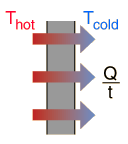
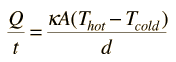
Conduction is heat transfer through solids and liquids by means of molecular agitation ( vibration and collision of molecules and free electrons ) within a material without any motion of the material as a whole. If one end of a metal rod is at a higher temperature, then energy will be transferred down the rod toward the colder end because the higher speed particles will collide with the slower ones with a net transfer of energy to the slower ones. For heat transfer between two plane surfaces, such as heat loss through the wall of a house, the rate of conduction heat transfer is:


  • Q = heat transferred in time =
  • K = thermal conductivity of the barrier W/m.K.
  • A = Area
  • T = Temperatur
  • d = thickness of barrier

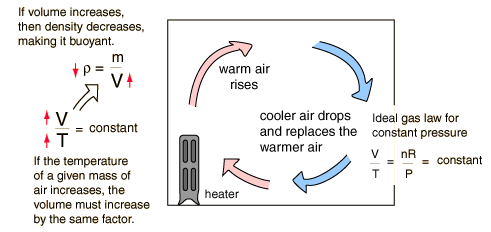
Convection is heat transfer by mass motion of a fluid (a liquid or a gas) when the heated fluid is caused to move away from the source of heat, carrying energy with it. Convection above a hot surface occurs because hot air expands, becomes less dense, and rises (see Ideal Gas Law). Hot water is likewise less dense than cold water and rises, causing convection currents which transport energy.
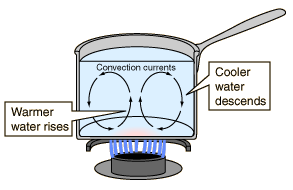
Convection can also lead to circulation in a liquid, as in the heating of a pot of water over a flame. Heated water expands and becomes more buoyant. Cooler, more dense water near the surface descends and patterns of circulation can be formed, though they will not be as regular as suggested in the drawing. when we heat water on a stove, the volume of water at the bottom of the pot will be warmed up by conduction from the metal of the pot and it will become less dense. Then, because it is less dense, it will shift upward to the surface of the volume of water and will displace to the upper -less hot and denser- mass of water
Formula of Convection:

q = hA (Ts - T ∞)

Where h is the constant for the convective heat transfer coefficient, A is the area implied, and Ts - T ∞ is the difference between the final temperature and the initial temperature.

.

Read More......

Sejarah dan Latar belakang perlunya Biodiesel

Posted by Mfatoni De CoSe | 11:34 AM | | 1 comments »

Biodiesel merupakan bahan bakar yang terdiri dari campuran mono--alkyl ester dari rantai panjang asam lemak, yang dipakai sebagai alternatif bagi bahan bakar dari mesin diesel dan terbuat dari sumber terbaharui seperti minyak sayur atau lemak hewan.

Sebuah proses dari transesterifikasi lipid digunakan untuk mengubah minyak dasar menjadi ester yang diinginkan dan membuang asam lemak bebas. Setelah melewati proses ini, tidak seperti minyak sayur langsung, biodiesel memiliki sifat pembakaran yang mirip dengan diesel (solar) dari minyak bumi, dan dapat menggantikannya dalam banyak kasus. Namun, dia lebih sering digunakan sebagai penambah untuk diesel petroleum, meningkatkan bahan bakar diesel petrol murni ultra rendah belerang yang rendah pelumas.

Salah satu masalah krusial yang dihadapi oleh bangsa Indonesia saat ini adalah energi. Pasokan
energi dalam negeri mengalami kendala akibat trend produksi yang cenderung lebih rendah dibanding tingkat konsumsinya.Total produksi minyak mentah dalam negeri saat ini sekitar satu juta barel per hari dengan tingkat konsumsi sekitar 1,2 juta barel per hari. [Jusuf Kalla, 7 Mei 2008]
Kebutuhan energi masyarakat dan industri setiap tahun meningkat. Kondisi ini harus diakomodasi oleh pemerintah melalui penyediaan energi dalam jumlah yang mencukupi dan harganya harus terjangkau oleh masyarakat.
Mengingat cadangan minyak bumi Indonesia yang makin menipis, impor minyak bumi yang semakin tinggi dan kenaikan harga minyak bumi dunia yang dapat dipastikan akan diikuti oleh kenaikan harga BBM sehingga berdampak pada kenaikan harga kebutuhan pokok di masyarakat maka diperlukan pengembangan energi alternatif terbarukan. Hal ini mengingat ketersediaan sumber tanaman penghasil minyak nabati yang cukup tinggi di Indonesia yang dapat dimanfaatkan sebagai bahan baku biodiesel.

Anggaran Pendapatan dan Belanja Negara Perubahan (APBNP) 2008 mengalokasikan dana untuk subsidi sebesar Rp234,41 triliun yang terdiri dari subsidi BBM senilai Rp126,82 triliun, subsidi listrik Rp60,29 triliun, subsidi pangan Rp8,59 triliun, subsidi pupuk Rp7,81 triliun, subsidi benih Rp1,02 triliun, Public Service Obligation (PSO) Rp1,73 triliun, subsidi bunga kredit program Rp2,15 triliun, subsidi minyak goreng melalui operasi pasar Rp500 miliar, subsidi kedelai Rp500 miliar, dan subsidi pajak Rp25,00 triliun. [www.antara.co.id, 23 April 2008 ]

Subsidi BBM senilai Rp126,82 triliun didasarkan pada parameter pehitungan volume premium 16,98 juta kl, minyak tanah 7,56 juta kl, minyak disel/solar 11 juta kl, volume minyak tanah dikonversi ke elpiji sebesar 2,01 juta kl, dan alpha sebesar 9 persen

Ide menggunakan minyak nabati secara langsung untuk mesin diesel sudah dilakukan orang lebih dari 100 tahun lalu. Rudolf Diesel yang merekayasa atau mencipta mesin diesel sudah melakukan demonstrasi mesin diesel yang memakai minyak kacang tanah sebagai bahan bakarnya.

Tetapi ada sejumlah hambatan yang dialami mesin diesel konvensional jika memakai bahan bakar minyak nabati secara langsung. Penyebab hal ini adalah bahwa derajat kekentalan (viskositas) minyak nabati adalah sepuluh sampai dua puluh kali viskositas solar (petrodiesel). Sifat fisik ini merupakan penyebab buruknya atomisasi dan mengakibatkan pembakaran tidak sempurna yang telah dites sejak tahun 1920 oleh ilmuan Madhot (1921)

Flash point (titik nyala) dari minyak nabati terlalu tinggi kurang lebih 240 oC dan kecenderungan terjadinya polimerisasi karena oksidasi dan pemanasan akan mengakibatkan pembentukan deposit (kerak) pada nozel injektor, pelarutan dan degradasi minyak pelumas mesin, dan ring sticking piston.
Oleh karena itu, operasi jangka/waktu panjang mesin diesel dengan bahan bakar 100% minyak nabati maupun campurannya dengan bahan bakar fosil akan mengakibatkan kerusakan (umur pendek) mesin diesel (Srivastava &Prassad, 2000). Oleh karena itu tidak direkomendasikan membakar minyak nabati (trigliserida) secara langsung pada mesin/motor diesel konvensional tanpa modifikasi.

Masalah-masalah ini dapat diselesaikan dengan menyesuaikan mesin pada spesifikasi bahan bakarnya maupun mendekatkan bahan bakarnya pada spesifikasi mesinnya. Tetapi pembuatan atau pengembangan mesin minyak nabati tidak banyak dilakukan pada saat ini. Strategi diarahkan untuk memodifikasi minyak nabati dengan berbagai teknologi untuk menghasilkan bahan bakar dengan sifat-sifat yang mendekati bahan bakar solar (konvensional). Pada saat ini yang memberikan konversi ataupun hasil paling tinggi adalah transesterifikasi minyak nabati ataupun esterifikasi asam lemaknya dengan produk yang dinamakan biodiesel.[http://che.itb.ac.id/biodiesel/]

Read More......